

Physics-based humanoid–scene interaction in simulation SIGGRAPH Asia 2026

CHIP Learning to move
and interact with the world.

Unifying Physics-Based Humanoid Interaction with a Context-Conditioned Interaction Prior

1The Chinese University of Hong Kong 2Monash University
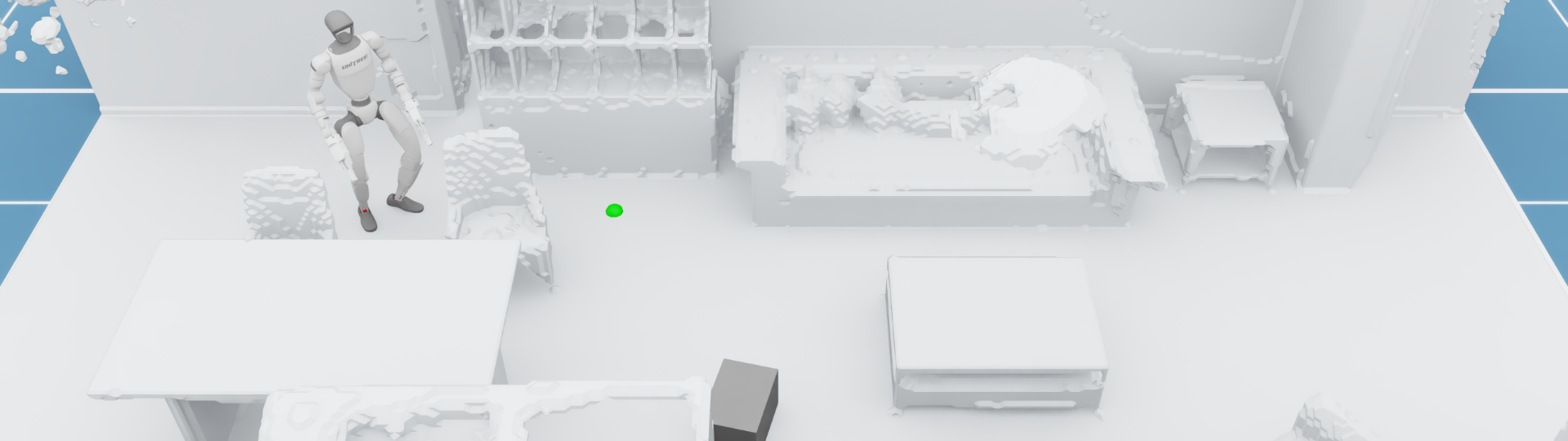
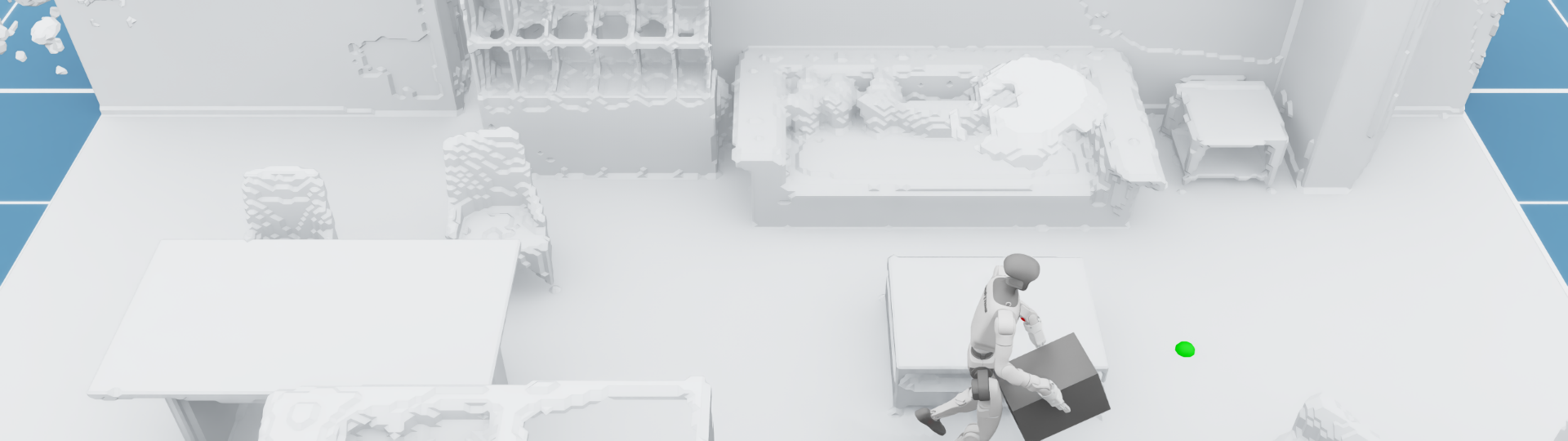
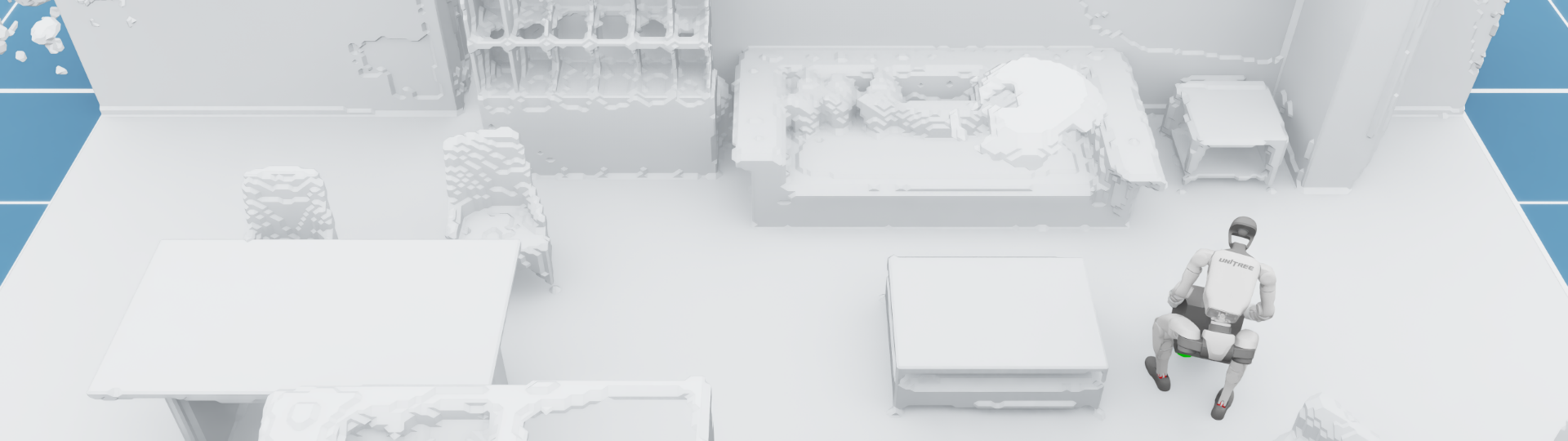
CHIP / Simulation roll 01 01 / 05
Humanoid starts in a furnished 3D scene Humanoid approaches a narrow gap Humanoid picks up an object Humanoid carries the object around an obstacle Humanoid places the object at the goal
Drag to scrub
01

Continuous behavior

Start

Observe the scene and begin a single, continuous interaction.

Start with the idea

Simulation gallery

Drag or scroll to explore
01 / NavigationScene rollout I
02 / NavigationScene rollout II
03 / NavigationWith subgoals
04 / InteractionObject rollout I
05 / InteractionObject rollout II
06 / CompositionContinuous task
01 / Abstract

From motion priors.
To interaction priors.

  • 01Heterogeneous Motion Data
  • 02Physics-Grounded Interaction Skills
  • 03Context-Conditioned Interaction Prior

Developing unified physics-based humanoid controllers that can navigate complex 3D scenes and manipulate objects remains a longstanding challenge. Existing approaches are often specialized for either locomotion or object-centric manipulation, or rely on task-specific reward engineering that does not scale well across diverse behaviors. We present CHIP, a unified, physics-grounded framework for learning reusable humanoid interaction skills from heterogeneous motion data. Central to our approach is a conditional interaction prior that models a context-dependent distribution over these skills within a shared discrete space. Our method is trained in three stages. We first learn physics-based motion-imitation policies that acquire grounded teacher behaviors from heterogeneous interaction data. We then distill these behaviors into a context-conditioned interaction prior that captures reusable motion structure across locomotion and manipulation. Finally, we initialize downstream task policies from the pretrained prior and adapt them through prior-regularized online RL post-training. Experiments on a diverse suite of humanoid interaction tasks show that our approach supports scene-aware locomotion, contact-rich object manipulation, and compositional behaviors such as environment-aware object transport and long-horizon skill sequencing, while producing smooth transitions and physically plausible motion.

02 / Method

Acquire. Distill.
Adapt.

A three-stage recipe turns heterogeneous demonstrations into a reusable interaction prior, then adapts it to new objectives without losing natural motion.

Framework overview Original schematic
The original research schematic: heterogeneous HSI and HOI behaviors share one conditioning interface across scene, object, and task context.
02 / Method CHIP framework overview
Enlarged CHIP pipeline showing the complete three-stage framework and downstream tasks

Full-resolution vector schematic. Swipe horizontally to explore the complete pipeline. Esc to close

Stage I01

Physics-based imitation

Specialist policies track retargeted human–scene and human–object motions inside physics simulation. Their rollouts provide grounded teacher behaviors spanning locomotion, whole-body object transport, and context-dependent interaction.

TrackingPPOSimulation
Stage II02

Generative distillation

A VQ-VAE compresses teacher transitions into a shared 1,024-entry discrete codebook. A transformer then learns a categorical prior over skill tokens conditioned on humanoid history together with scene, object, and task context.

VQ-VAETransformerCategorical prior
Stage III03

RL post-training

Each downstream task policy is initialized from the pretrained prior and optimized with PPO. KL regularization toward a frozen, CFG-guided prior encourages task adaptation while retaining interaction structure learned from the demonstrations.

PPOKL priorSimulation
03 / Behaviors

What the prior
enables.

Policies adapted from the same prior support scene navigation, object transport, and their composition in continuous episodes.

01 / Navigate

Whole-body
scene awareness

Rotate, step sideways, and reshape posture to traverse narrow gaps with fewer collisions.

Clips
02 / Locomanipulate

Carry while
avoiding obstacles

Transport an object while continuously adapting whole-body motion to nearby scene geometry.

Clips
03 / Compose

Navigate. Pick.
Carry. Place.

Compose navigation and manipulation in one continuous episode. The policy is learned through RL post-training with a scripted stage transition, without complete trajectories in the pretraining motion data.

04 / Results

Quantitative evaluation

The experiments test whether a shared interaction prior can support scene navigation, object relocation, and composition. Results follow the paper's in-distribution protocol, with an additional held-out-scene evaluation.

Task success rate (%)
Method Scene navigation Object relocation Composition
CHIP Ours 90.1 88.2 71.4
TokenHSI 93.3 84.8 66.8
MaskedMimic 33.8 44.1 0.0

Additional CHIP metricsNavigation collision score: 0.02 · Object final distance: 0.10 m

Values are reproduced from Table 1 in the paper. The comparison uses randomized in-distribution evaluation on scenes and object instances used for downstream training.

Held-out scenes

Evaluation on held-out scenes.

CHIP retains high navigation and composition success in held-out scenes.

Navigation success
86.1%
Composition success
60.2%
05 / Citation

Citation.

If CHIP helps your research, please cite the paper.

cite.bib
@inproceedings{li2026chip,
  author    = {Li, Jianan and Chen, Xiao and Wong, Tien-Tsin},
  title     = {Unifying Physics-Based Humanoid Interaction with a Context-Conditioned Interaction Prior},
  year      = {2026},
  publisher = {Association for Computing Machinery},
  address   = {New York, NY, USA},
  booktitle = {SIGGRAPH Asia 2026 Conference Papers},
  series    = {SA Conference Papers '26},
  location  = {Kuala Lumpur, Malaysia},
  isbn      = {979-8-4007-2842-6},
  doi       = {10.1145/3829340.3842357}
}
BibTeX copied